taiwan story

HOW ESWATINI’S MAINSTREAM MEDIA PEDDLES FALSE NARRATIVES

Eswatini’s mainstream media continues to play a troubling role in shaping public understanding of critical national issues by promoting misleading narratives rather than rigorous analysis.
 
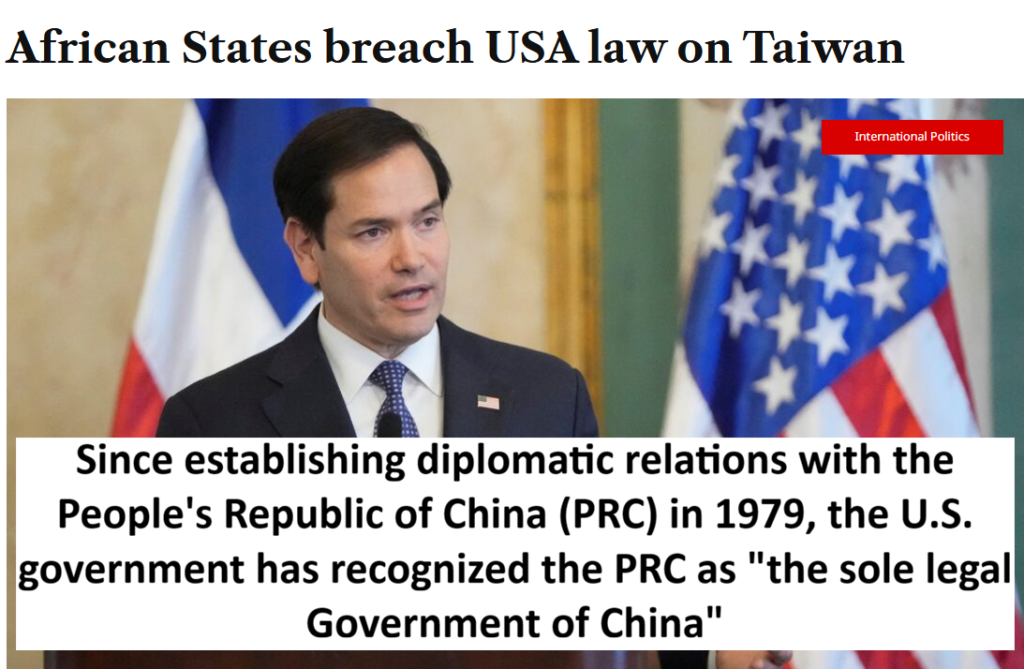
A recent example is the sensational framing of African countries allegedly “breaching U.S. law” over Taiwan-related diplomatic decisions.
 
Such reporting reveals how easily media outlets can distort international affairs, creating confusion rather than clarity.
 
The Truth about the Taipei Act (2019)
 
The portrayal of the U.S. TAIPEI Act as an automatic punitive legal instrument is fundamentally misleading.
 
The Act does not impose direct sanctions on countries simply for making diplomatic or aviation decisions unfavourable to Taiwan.
 
Rather, it gives Washington discretionary authority to adjust engagement based on broader strategic considerations.
 
Presenting it as a strict legal mechanism falsely suggests that sovereign African states are directly violating U.S. law, which is not the case.
 
 The Oversimplification of International Relations Norms and Laws
 
The suggestion that denying overflight rights to Taiwanese officials constitutes a legal violation oversimplifies international relations.
 
Airspace decisions, while politically sensitive, remain within the sovereign authority of states. These choices may invite diplomatic criticism, but they do not automatically amount to unlawful conduct under American legislation.
 
By framing such actions as “illegal,” the media substitutes geopolitical rhetoric for factual legal analysis.
 
Not Official Policy
 
Eswatini’s media often blurs the line between political opinion and official policy. Statements by individual U.S. lawmakers are frequently reported as though they represent definitive American government action.
 
This creates the false impression that punitive consequences are immediate or inevitable, when in reality such remarks may simply reflect political posturing rather than formal diplomatic measures.
 
Exaggeration and Blatant Lies
 
The media also exaggerates potential economic consequences, such as immediate loss of AGOA benefits or sweeping sanctions, without acknowledging the complexity of international policy processes.
 
Diplomatic shifts can indeed carry consequences, but these are negotiated through strategic calculations, not automatic triggers.
 
Fear-driven reporting inflates uncertainty and undermines public understanding of foreign policy realities.
 
This pattern reflects a broader issue within Eswatini’s information landscape: mainstream narratives often serve elite political interests rather than public enlightenment.
 
By amplifying exaggerated external threats, media institutions help preserve the illusion that current diplomatic arrangements are unquestionable necessities, rather than contested policy choices.
 
Eswatini’s Foreign Relations are Royal Whims
 
Ultimately, Eswatini’s diplomatic ties – whether with Taiwan, China, or Western powers – are not the product of genuine national consensus.
 
Ordinary emaSwati have no influence over these decisions, which are largely shaped by political and economic elites pursuing their own strategic interests.
 
That is perhaps the most worrying reality of all: not simply the spread of false narratives, but the deeper absence of democratic accountability in determining the nation’s place in an increasingly competitive global order.

Support Our Mission

A Small Act of Kindness Goes a Long Way

Every little support truly counts.

No thanks I don't want to donate