tvet blues

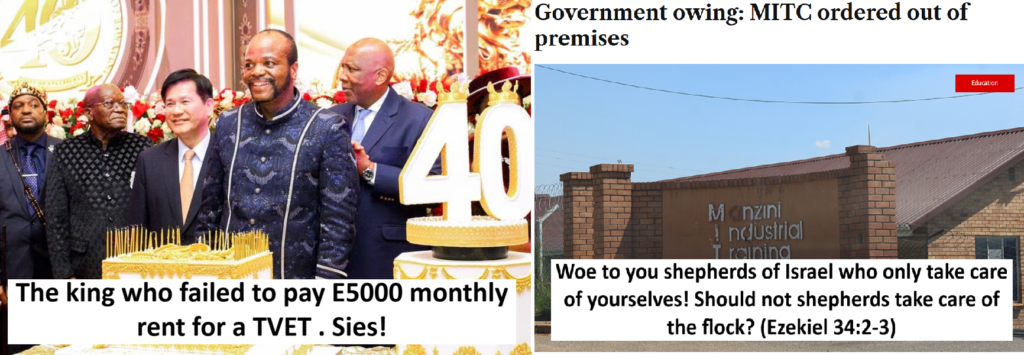
KING MSWATI EVICTED FROM MITC PREMISES OVER E336 936.60 UNPAID RENT

In a striking and deeply symbolic development, the Anglican Church has successfully evicted King Mswati’s government from the premises of the Manzini Industrial Training Centre (MITC) after prolonged rental arrears.
 
This is no ordinary landlord dispute. It is an extraordinary indictment of governance in Eswatini.
 
A Brief History of MITC
 
The Anglican Diocese of Swaziland, which built MITC in the 1980s to equip young people with practical industrial skills, had originally established the institution as part of its mission to serve the country’s youth.
 
As financial pressures mounted over time, the Church handed operational control to the government, reasonably assuming that the state would sustain and expand such a critical developmental asset.
 
Instead, chronic neglect followed.
 
For years, MITC reportedly suffered from underfunding and institutional decline under government management.
 
Matters deteriorated to the point where even nominal rental obligations – reportedly around E5,000 per month for large premises, likely covering little more than maintenance and municipal rates – were not honoured.
 
That failure matters.
 
The High Court Evicted the King
 
In Eswatini’s political system, where executive authority is centralized under an absolute monarchy, ministries and state institutions ultimately function under royal authority.
 
This makes the eviction symbolically profound: the High Court, acting on behalf of the Anglican Church’s legal rights, effectively ordered the removal of the king’s government from church property due to unpaid rent.
 
For a regime capable of financing royal luxuries, prestige infrastructure, and billion-emalangeni vanity projects, defaulting on a heavily subsidized educational facility reveals more than financial strain; it reveals misaligned national priorities.
 
Why Vocational Training is Crucial
 
Technical and Vocational Education and Training (TVET) institutions like MITC are indispensable to developing economies.
 
Emerging nations require electricians, welders, mechanics, plumbers, builders, and technicians at scale if they are to industrialize, expand infrastructure, and reduce unemployment.
 
A country cannot sustainably modernize by producing white-collar workers alone while neglecting its skilled labour base.
 
Universities matter, but in many developing contexts, widespread vocational competence often delivers more immediate economic transformation than elite professional overproduction.
 
Eswatini’s Government is Mismanaging the Economy
 
The MITC saga, therefore, represents something larger than unpaid rent. It is a reflection of a state structure that appears more capable of funding spectacle than sustaining practical development.
 
While royal prestige projects capture headlines, one of the nation’s few vocational training centres has become a legal casualty of governmental neglect.
 
The message from the Anglican Church is unmistakable: if the state cannot meet even its most basic obligations to institutions that build national capacity, then its rhetoric about development rings hollow.
 
In many ways, this eviction is more than a property dispute; it is a national metaphor. Eswatini’s crisis is not merely about resources, but about priorities

Support Our Mission

A Small Act of Kindness Goes a Long Way

Every little support truly counts.

No thanks I don't want to donate